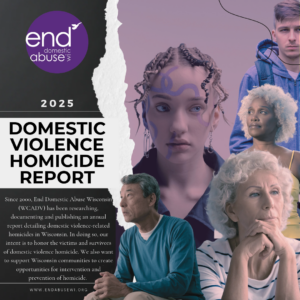
The 24th annual report examines domestic and family violence fatalities across Wisconsin, with a focus on firearms, abuse in later life, housing, and opportunities for prevention.
During Domestic Violence Awareness Month, End Domestic Abuse Wisconsin is releasing its 2025 Domestic Violence Homicide Report, documenting 101 fatalities related to domestic and family violence across Wisconsin in 2025.
Of those 101 deaths, 60 people were victims of domestic violence homicide.
Each number in this report represents a person whose life extended far beyond the circumstances of their death. They were family members, friends, neighbors, coworkers, parents, children and members of Wisconsin communities.
For 24 editions, End Domestic Abuse Wisconsin has documented domestic violence-related homicides in our state. We do this not simply to count deaths, but to honor those whose lives were taken, identify patterns that can inform intervention and prevention, and help communities understand where opportunities for safety may have been missed.
This year’s report again makes clear that domestic violence homicide is not an isolated or private tragedy. What happens inside a relationship is shaped by what exists outside of it: access to safe housing, firearms, economic resources, community support, advocacy services and systems prepared to recognize escalating danger.
Firearms continue to make domestic violence more lethal
In 2025, 72% of domestic violence homicide victims were killed with a firearm.
The report also found that 14 people killed with firearms were killed by someone who was legally prohibited from possessing one.
Those numbers demand more than acknowledgment.
When we talk about domestic violence prevention, we must also talk about lethality. We must be willing to recognize the role firearms play when abuse escalates and examine whether the protections intended to keep survivors safe are working as they should.
The report also draws attention to the relationship between homicidality and suicidality in domestic violence cases. These risks cannot always be understood or addressed separately. Recognizing threats, stalking, strangulation, weapon threats and other indicators of escalating danger can create critical opportunities for intervention.
Domestic violence does not stop at a certain age
One of the clearest messages in this year’s report is that our understanding of domestic violence must include survivors across the lifespan.
In 2025, 19 domestic violence homicide victims were age 50 or older—more than one-third of all domestic violence homicide victims documented in the report.
Older survivors can face distinct barriers to safety, including health and mobility needs, financial dependence, caregiving relationships, isolation, decades-long relationships and systems that may not recognize what they are experiencing as domestic violence.
Abuse does not disappear when someone reaches a certain age. Our prevention, intervention and support systems cannot behave as though it does.
Housing is violence prevention
We often ask survivors why they did not leave.
We ask far less often whether leaving was actually possible.
Could they afford housing? Was shelter available? Could they bring their children? Was there somewhere safe to go? Could they remain in their community? Did they have access to transportation, income and the resources necessary to begin again?
The 2025 report highlights housing as a critical component of homicide prevention, including lessons from the Domestic Violence Housing First pilot project and the importance of helping survivors access stable housing before violence becomes lethal.
Housing is not separate from survivor safety.
Housing is violence prevention.
Domestic violence programs across Wisconsin understand this every day. Their work extends far beyond emergency shelter. Programs provide advocacy, safety planning, housing assistance, legal support, basic necessities and other services that help survivors create options when abuse has deliberately taken options away.
The report is not where the conversation ends
Domestic Violence Awareness Month gives us an opportunity to talk about domestic violence.
But awareness alone cannot be our destination.
The value of this report is not simply knowing how many people died. It is asking what these deaths can teach us about the conditions surrounding domestic violence in Wisconsin; and what we are willing to change because of what we now know.
That means investing in survivor services and stable housing. It means taking indicators of escalating lethality seriously. It means strengthening coordination among advocates and the systems survivors encounter. It means recognizing survivors across age, race, gender, sexuality, disability, geography and circumstance. And it means ensuring that protections intended to reduce access to firearms by people legally prohibited from possessing them are meaningful in practice.
Most importantly, it means remembering that behind every statistic is a life.
For more than two decades, End Domestic Abuse Wisconsin has collected this information with the intention of honoring victims and survivors, strengthening community understanding, and creating opportunities for intervention and prevention.
101 lives were lost in 2025.
We owe them more than a number in an annual report.
We owe them our attention.
We owe survivors meaningful options for safety.
And we owe our communities the willingness to use what we know to prevent the next death.
The data calls for action.
Read the 2025 End Domestic Abuse Wisconsin Homicide Report
Need support? Domestic violence programs throughout Wisconsin provide confidential advocacy and support to survivors. End Domestic Abuse Wisconsin maintains resources to help people connect with services in their communities. End Domestic Abuse Wisconsin
Find domestic violence help and resources in Wisconsin